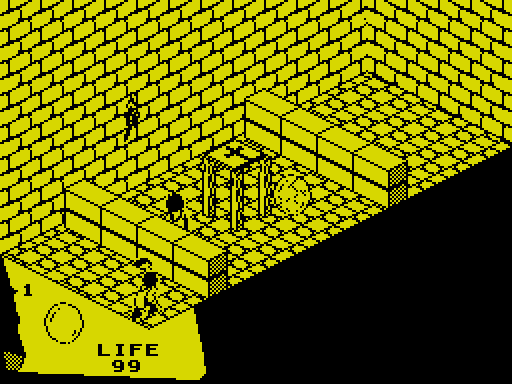
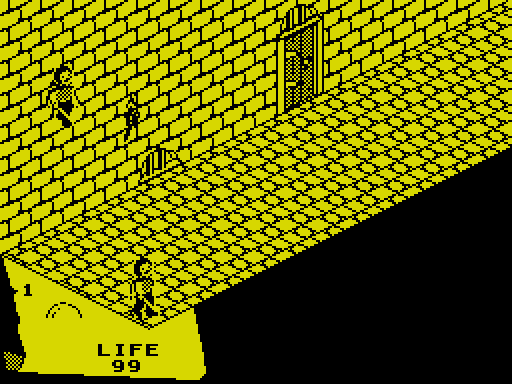
Room 19's two things wreck a door in room 25
Every thing the knight can carry from room to room has a number, its place in
the object table (
OBJECTS), and its record keeps it at +19 (
PLACE_ROOM_OBJECTS). When a
thing is picked up, dropped, stolen or destroyed,
SET_THING_ROOM (the
author's ROMM) finds its entry by counting six bytes a number from just below
the table, with DJNZ; and when the knight leaves a room,
EEN saves
where each thing is the same way. Room 19's drawing places two things of its
own -- kind 4 (used, they add ten to LIFE), bouncing, hurting at a touch, and
able to be picked up -- which are not in the table and so have number 0. For
them DJNZ goes round 256 times, and the byte written is 1536 bytes on: $AF1E,
the third byte of an eleven-byte entry, the door from room 25 to room 21.
Its x is 50.
Run in the simulator (checked at every build): as the game starts, the knight
put in that doorway and walked into it arrives in room 21. In room 19,
put ten units short of one of the two things, X took it
(LIFE unchanged), and $AF1E became $FE, the room
SET_THING_ROOM gives a thing carried. The door's record in room 25 now had x
254, far outside the room, and walking into the doorway left him in room
25: the door no longer exists. Dropping the thing writes the room
it is dropped in instead, so carried to room 50 and dropped there it put
back the 50 the door had, and room 25's doorway led to room
21 again. Carried out of room 29 by its door to room 30, its
record -- a carried thing's record comes straight after the knight's -- came
before the room's doors, so EEN wrote its position (100, 76, 130) over the next three bytes of the same entry: the
door's destination, its key and the x the knight arrives at became
100, 76, 130. From then on the door, wherever its x, leads to room
100, which does not exist, and wants thing 76 as its key.
They are the only numberless things that can be carried: every room 2 to 80
was entered in the simulator (at every build) and every record read, and no
other record with a sprite and number 0 can be picked up, stolen by the ghost
or destroyed with a wraith, the three ways to SET_THING_ROOM. Reaching one is the only
difficulty: it hurts at a touch, costing ten LIFE and vanishing
(
OBJECTS_MEET), and the pick-up's search reaches four units past the knight.
The author may have met the same trouble once: the five bytes the pits'
code jumps over (
SKIPPED_REMOVAL) would have called SET_THING_ROOM for the knight,
whose number is 0 too (read; why they are skipped is not known).
Release 1: a jump while the creatures are frozen stops the knight for good
Using a thing of kind 5 freezes the creatures until the next room:
MAIN_LOOP
sets bit 7 of GAME_FLAGS, which only a room's entry clears (
DRAW_STILL_THINGS). While
it is set,
CHE3D sends the knight's state, 8, to his controls
($F3CD) and treats every other state as state 0, a thing lying still:
only the fall. The knight's jump is state 5, counted down by its own case and
ended by setting state 8 again. Release 2 lets state 5 through as well
(CP 5 : JR NZ at $F263). Release 1 has JR I00 there: a jump that begins
during the freeze is handled as a thing lying still, nothing counts it down,
and state 8 never comes back. With no controls he cannot walk to another
room, the only thing that ends the freeze.
Run in the simulator (at every build), Release 2 as it is and with Release
1's two bytes put in its place: in room 24 its thing of kind 5 was picked
up and used (GAME_FLAGS $80), SPACE held for two passes, and the
knight's state noted each pass for twenty. Release 2: 8 5 5 5 5 5 5 5 5 8 8 8 8 8 8 8 8 8 8 8,
and then Q moved him 20 units in ten passes. Release 1's instruction:
8 5 5 5 5 5 5 5 5 5 5 5 5 5 5 5 5 5 5 5, and Q moved him 0. The same trial on
Release 1 itself, loaded from its own tape, gave the same states. Ending the
game with SYMBOL SHIFT and 0 is the way out (see
the facts); a new game starts with the freeze
cleared. This is surely why Release 2 changed that instruction and no other
in the object dispatcher (inferred;
the
facts list what else changed).
A decoy on the floor hides the thing of kind 11
Each pass
CHE3D notes, among the things lying still, the first decoy
(kind 8, which the guards of state 9 go after) and whether a thing of kind 11
lies in the room; room 61 waits for that thing -- its creature stays still and
its one way out, a hole down to room 60, stays shut until it lies there
($F3A1,
BUMPED). The test for kind 11 (CP $0B at $F245) compares A, which holds
the thing's kind only on the way in that has just found no decoy. Once a decoy
is known, the other way in reaches the same CP with A holding the thing's
state, 0 for anything lying still. So a thing of kind 11 whose record comes
after a decoy's is never noticed. (With the creatures frozen, a wraith's state
11 would pass the test instead; nothing the flag controls is affected by that
outside room 61.)
Run in the simulator (at every build): the decoy (thing 11, from room
20) and the thing of kind 11 (thing 7, from room 14) fetched into two
places, carried into room 61 and dropped there, place 1 first. A carried
thing's record keeps its place's order, so the first place's thing is looked
at first each pass. Decoy in place 1: THINGS_NOTED stayed
$01 for forty passes, the creature moved 0 units, and the
knight put on the hole stayed in room 61. The other way round:
THINGS_NOTED $03, the creature, woken, moved 60
units, and the hole took him to room 60. Picking the decoy up again
clears the flags and puts things right. Only room 61 cares, and only a
player who brings a decoy there and drops it before the thing of kind 11
meets it.
Two redraws read a record number after it has changed
FOUND_RECORD ($FFF8) holds the number of the record a search last met
(
FIND_OBSTACLE, the author's T+20); it is also where
DRAW_SPRITE keeps a sprite's width
in bytes while drawing it. Twice the game reads it as a record's number when
something has been drawn since the search, so that it holds a width.
OBJECTS_MEET, when a thing has vanished or a guard has
become a helmet, finishes the mover's move -- redrawing the mover -- and then
takes FOUND_RECORD as THIS_RECORD for redrawing the other ($FA0D); the
pick-up (
PICK_UP_LOOK_ON) redraws the knight stooping, then does the same for the thing
it has taken ($F57E). THIS_RECORD is the one record
REDRAW_OBJECT leaves out
of a redraw, and a width in bytes is 1 to 6 -- no sprite is wider than 48
pixels -- which is always one of the six fixed records the redraw never
looks at anyway. So nothing is left out. A thing that has vanished or been
taken is left out regardless (
CULL_OBJECT skips a record whose bit 5 of +16 is
set); a helmet is not, and is taken as lying in front of itself, so for one
pass the screen keeps what it showed inside the helmet's shape.
Run in the simulator (at every build): room 20's decoy picked up,
FOUND_RECORD was 9 (the decoy's record) at TAKE_THING and THIS_RECORD was given
3. In room 77, the knight fighting with B held until the guard's
last strike: THIS_RECORD was given 3 for the helmet, record 8.
Given 8 instead, the screen after the redraw differed in
1 pixel, and after the next pass in 0: the helmet lies
mostly behind the knight, where the old picture and the new one agree. Harmless
in practice.