The author's source text and symbol table, left in memory
The tape carries more than the game. When Bo Jangeborg saved it, parts of
his assembler's working memory went with it: pieces of the game's own source
text -- numbered lines, the fields separated by tabs, in several stretches
(
SOURCE_AND_STACK,
SOURCE_BEFORE_OBJECTS,
RECORDS,
SOURCE_AFTER_START,
SOURCE_AFTER_OBJECTS,
SOURCE_AFTER_TEMPLATES and others) -- and part
of the assembler's symbol table (
SYMBOL_TABLE), whose 64 whole names and values are this very
release's: 20 of them are the first instruction of a routine in this listing.
The game never reads either, and much of the text is overwritten when the
game starts. They give the listing many of its names: ROOMST, ZOOMIN, CHE3D,
EEN, MESS2, WAIT, PRINT, and the labels I0 to I95 inside
CHE3D. The text
also shows that he reached the variables at $FF80 as V+n and the working
copy of a record at $FFE4 as T+n.
Here, read from the snapshot at build time, are his lines for the end of the
pick-up (the lines from WEI3 to its RET, at
SOURCE_AND_STACK); 28 of the 28
begin with the same instruction as the game's code from $F555 on
(
PICK_UP_LOOK_ON), which is what they assembled to:
6260 WEI3  LD     (V+18),A
6270       PUSH   IX
6280       POP    DE
6290       LD     H,255
6300       LD     L,(IY+30)
6310       LD     (HL),E
6320       INC    HL
6330       LD     (HL),D
6340       SET    5,(IX+16)
6350       RES    7,(IX+14)
6360       RES    1,(IY+17)
6370       LD     C,254
6380       CALL   ROMM
6390       PUSH   IX
6400       CALL   DOE
6410       POP    HL
6420       LD     A,(V+3)
6430       PUSH   AF
6440       LD     A,(T+20)
6450       LD     (V+3),A
6460       PUSH   HL
6470       CALL   SRP
6480       POP    HL
6490       CALL   INFOR
6500       POP    AF
6510       LD     (V+3),A
6520       LD     (IY+17),0
6530       RET
ROMM is
SET_THING_ROOM, DOE the instruction at $F4E3, SRP
REDRAW_OBJECT and INFOR
SHOW_THING_IN_USE.
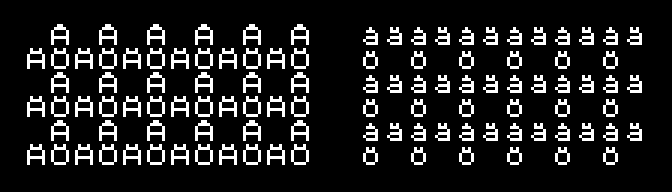
Swedish letters among the textures
The fills that give the rooms their stone, brick and wood take their pattern
from 26 textures of 16 by 16 pixels (
TEXTURES). Two of them are not patterns
at all: texture 22 (
TEXTURE22) holds the capitals Å, Ä and Ö, texture 23
(
TEXTURE23) the small å, ä and ö -- the three letters the Swedish alphabet has
beyond the English one. The game's font (
FONT) has no use for them, and
no room fills with either (read: every room's and part's commands, counted at every
build). A reasonable guess is that they belong to the author's own tools, left
among the textures; Bo Jangeborg is Swedish.
Drawn by the game's own fill (at every build): two boxes outlined into the
fill's map and filled with fill codes $FC and $FD by
DRAW_ROOM_RECORD, the way a room
is drawn:
Interrupts off, all game
The game runs with interrupts disabled. The only EI and DI instructions in it
are DI at $C00B, EI at $C018, DI at $C487 (searched, at every build). The loading
tune (
LOADING_TUNE) turns interrupts off while it plays and on as it ends, for
two instructions: the start-up's DI ($C487) comes straight after and nothing
turns them on again. It has to: the sprites at
SPRITE5B00 lie over the ROM's
system variables, where the ROM's interrupt routine would count FRAMES and
scan the keyboard fifty times a second. Nothing paces the game either: each
pass of the main loop (
MAIN_LOOP) takes as long as its room takes to update.
Run in the simulator (at every build): the interrupt flip-flop was
0 at the first pass of a game.
6 and 7 use, and SYMBOL SHIFT with 0 ends the game
The title page lists the walking, jumping, fighting, taking and dropping
keys. The others are read by the main loop (
MAIN_LOOP): 1 to 5 choose one of
the five places a thing is carried in; 6 or 7 use the thing in it (a thing of
kind 4 adds ten to LIFE, 6 fills it, 5 freezes the creatures, 9 carries the
knight off to room 30, and each is used up); SPACE with SYMBOL SHIFT pauses
until a key; 9 turns the Kempston joystick on and off; and 0 with SYMBOL
SHIFT returns from the game at once, to GAME OVER with LIFE still in hand.
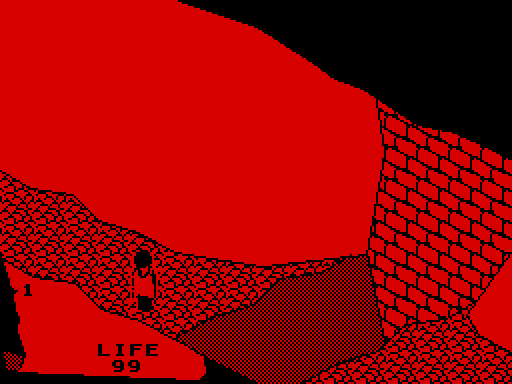
Read, and run in the simulator (at every build): SYMBOL SHIFT and 0 held at
a pass ended the game with LIFE at 99.
A trapdoor in room 10 ends the game
Every door's record names the room behind it (
BUMPED), and one names room 0:
a hole in the floor of room 10, which the knight falls through. There is no
room 0. $F8EC goes to
ROOMST with it as it would for any room,
and ROOMST's first test is for room 0, on which it returns -- the way the
main loop leaves it at the end of a game. So the fall ends the game on the
spot, whatever LIFE is left, with GAME OVER.
Run in the simulator (at every build): room 10 entered, and the knight put
over the middle of the hole (x 50 to 130, y 44 to
84) with H held: the game returned from ROOMST with LIFE at
99, drew room 1 behind GAME OVER and waited for a key.
What Release 2 changed
Fairlight came out twice on tape for the 48K Spectrum, and this is Release 2.
Compared byte for byte with Release 1, both loaded from their tapes and
stopped where the loader hands over, it changes five things. The Kempston
joystick, which Release 1 has switched off (its reading routine starts XOR A
: RET), becomes an option: 9 turns it on and off (
MAIN_LOOP,
IN31), and the
title page says so. The setting up of the tables moves out of the title
routine into the start-up (
START), in memory the game overwrites once it
runs, 52 bytes the resident code no longer needs. The object dispatcher lets
the knight's jump through the freeze (see
the
bugs). Room 67 loses a part it drew and an origin it set. Three door
records differ in a byte each. Everything else that differs is leftover
text, the symbol table's values and the loader's checksum. The rooms, the
sprites and the templates are the same.
Who made it
The title page (
TITLE_PAGE_TEXT) names Bo Jangeborg and The Edge, and no one else. ZXDB
(
its entry) credits Bo Jangeborg with the code, the
design, the level design, the story and in-game graphics; Jack Wilkes with
in-game graphics and the loading screen; Niclas Osterlin with in-game
graphics; Mark Alexander with the music (the loading tune,
LOADING_TUNE); and
Stuart Hughes with the inlay's art. It was published by The Edge in 1985 at
£9.95, as Fairlight: A Prelude, and its last lines (
MESS2) point to
the sequel, Fairlight II.
Where this reading differs from Krumlinde's
Ville Krumlinde's disassembly (
FairlightZ80),
labelled and commented, came first, and this one was made beside it; many of
its names and findings are his, credited where they are used. His snapshot
was taken in the middle of a game, which hid the start-up and the loader from
him, and several of his conclusions come out differently here. Each was
checked against the code, and those marked run also in the simulator:
- The entry point. He starts at the title routine (TITLE_SCREEN) and
rebuilds the stack for it; the loader returns to START, which sets the stack,
plays the loading tune, sets IY, puts the tables in place and then jumps to
the title (run).
- Interrupts. He has the ROM's interrupt running fifty times a
second; the start-up turns interrupts off for good (read and run; see
above).
- The compositor's four pages. He concludes that two of the four
256-byte pages at $D800 (COMPOSITE_TO_SCREEN) never reach the screen; the compositor
reads all four, stepping from one to the next, and the pages behind the
moving object carry the objects behind it (read, and run: the pages drawn
out in the middle of a redraw).
- The textures. He reads a texture as sixteen rows of two bytes;
bytes 8 to 15 are the right-hand half of the same eight rows, a 16 by 16 tile
in four 8 by 8 cells (read, and drawn: the brick textures only join up this
way).
- The room's box. The six records before the knight's
(FIXED_RECORDS) are the floor, the ceiling and the four walls, which a room's patch
codes set (DO_ROOM_COMMAND); he has the patches changing the object table (read, and
run: the records read in every room).
- Saving the room's things. EEN copies each thing's position
from its record into the object table as the knight leaves, not the other way
(run).
- The use key is 6 or 7, not 0; 0 with SYMBOL SHIFT ends the game,
and SPACE with SYMBOL SHIFT pauses (run).
- The carried things. $FD9C (the author's ROS) walks the five places
a thing is carried in, not a list of the room's objects (read).